A five-step framework that has guided effective training design for fifty years, and why it still matters.
Most organizations understand that training matters. Fewer have thought carefully about how training should be designed. The difference between a program that changes how people work and one that is quickly forgotten often has less to do with the subject matter than with the process used to create it.
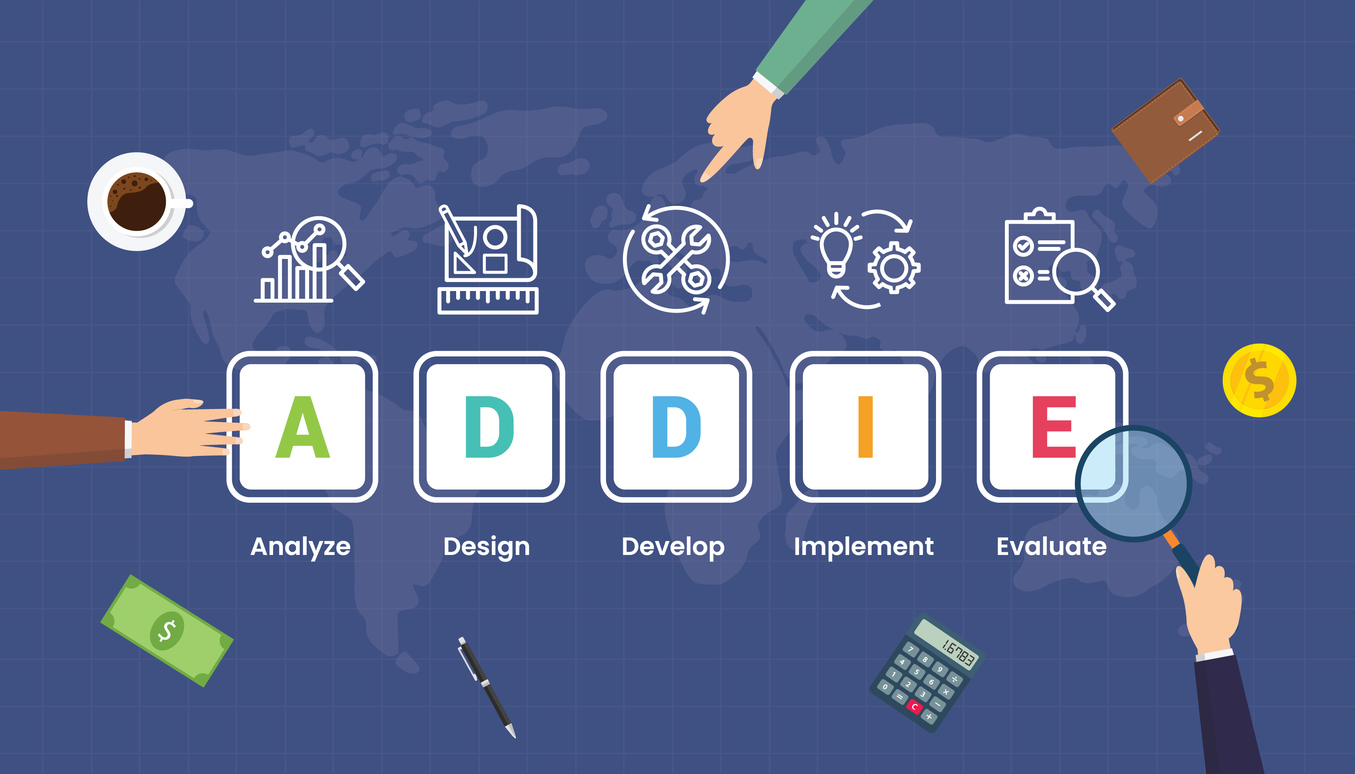
The ADDIE model is that process. It is a five-phase framework for designing, building, and evaluating training programs that has been used in military, corporate, nonprofit, and educational settings for more than fifty years. The name is an acronym for its five phases: Analysis, Design, Development, Implementation, and Evaluation.
Understanding ADDIE does not require a background in instructional design. What it requires is an appreciation for a straightforward idea: training works better when it is planned deliberately, built around the actual needs of the people receiving it, and reviewed honestly after the fact. That idea is what ADDIE puts into practice.
The History and Origin of the ADDIE Model
The ADDIE framework was developed in 1975 by the Center for Educational Technology at Florida State University, working under contract with the U.S. Army. The challenge the Army faced at the time was a familiar one: the equipment and systems that soldiers needed to operate were becoming increasingly complex, while the educational backgrounds of new recruits were highly varied. The goal was to find a systematic way to design training that would reliably prepare people to do specific jobs, regardless of where they started.
The resulting framework, originally called the Interservice Procedures for Instructional Systems Development, was quickly adopted across all branches of the U.S. Armed Forces. Over the following decades it was adapted and refined, and the five-phase structure that emerged became the model that training professionals and organizations around the world now recognize as ADDIE.
What is notable about this history is not just the longevity of the model, but the nature of the problem it was designed to solve. The Army needed training that worked under real conditions, with real people, at scale, and with measurable results. That is precisely the same challenge that nonprofits, businesses, and public sector organizations face today. The model has endured because the underlying problem has not changed.
The Five Phases of the ADDIE Model, Explained in Plain Terms
Each phase of ADDIE addresses a distinct question in the training design process. Together they form a logical progression from identifying a need to confirming whether it was met.
Analysis: What does the training actually need to accomplish?
The first phase is about understanding the situation before designing anything. This means identifying who will receive the training, what they currently know and can do, what they need to know and be able to do afterward, and what constraints exist around how the training can be delivered. It also means confirming that a training gap actually exists. Not every performance problem is a training problem, and the analysis phase is where that distinction gets made.
For a team struggling with a new software rollout, for example, this might mean determining whether the issue is a lack of technical knowledge, a lack of clarity about the organization’s specific processes, or something else entirely. The answer shapes everything that follows.
Design: What will the training look like?
The design phase translates the findings from analysis into a plan. This includes defining specific learning objectives, deciding on the sequence and structure of the content, choosing appropriate formats and methods, and determining how learners will be assessed. The design phase does not yet produce training materials. It produces the blueprint for them.
A well-constructed design phase is what prevents training from becoming a collection of information delivered in the hope that some of it sticks. Clear objectives give both the trainer and the learner a shared understanding of what success looks like, and they make the evaluation phase possible.
Development: Building the training materials.
This is the phase where the training is actually created: the presentations, exercises, reference materials, online modules, scenarios, or whatever formats the design phase specified. Development also includes testing materials with a representative group of learners before full delivery, so that problems can be identified and corrected while changes are still straightforward to make.
The quality of the development phase depends directly on the quality of the analysis and design that preceded it. When those earlier phases are done well, the development phase has clear direction. When they are skipped or rushed, the development phase typically involves a great deal of revision.
Implementation: Delivering the training.
Implementation is the phase most people think of when they think of training: the actual sessions, courses, or learning experiences being delivered to the people who need them. But in the ADDIE framework, implementation is not simply a matter of scheduling and showing up. It includes preparing the trainers or facilitators, ensuring that the technical and logistical environment is ready, and supporting learners through the experience.
For organizations running training across multiple teams or locations, the implementation phase also addresses consistency. One of the recurring challenges in workplace training is that the quality and content of delivery varies significantly depending on who is leading it. A well-structured implementation plan reduces that variability.
Evaluation: Did it work, and what should change?
The final phase assesses whether the training achieved what it set out to achieve. This happens at two levels. Formative evaluation occurs throughout the process, gathering feedback that can be used to improve materials and delivery while the program is still running. Summative evaluation takes place after the training is complete and measures outcomes against the objectives established in the design phase.
Evaluation is the phase most frequently skipped or reduced to a satisfaction survey at the end of a session. That kind of feedback has its place, but it does not answer the more important questions: did behavior change? Did performance improve? Did the training address the gap that was identified in the analysis phase? ADDIE treats evaluation as a structural component of training design, not an optional addition.
What Makes the ADDIE Model an Effective Training Framework
The ADDIE model has been in use for more than fifty years across an extraordinary range of contexts, from military training programs to corporate onboarding to public health education. That longevity is not accidental. It reflects something genuinely useful about the model’s structure.
It starts with the problem, not the solution.
A common pattern in organizational training is that the format is decided before the need is understood. An organization decides it needs a workshop, or an online course, or a half-day session, and then looks for content to fill it. ADDIE reverses that sequence. The analysis phase requires an honest examination of what the actual gap is before any decisions about format or content are made. That discipline alone produces better training outcomes.
Each phase builds on the one before it.
The five phases of ADDIE are not independent steps that can be completed in any order. Each one depends on the work done in the previous phase. The design cannot be completed without the findings of the analysis. The development cannot be completed without the blueprint from the design phase. The evaluation cannot be conducted without the objectives established in the design phase. This sequential logic is what gives ADDIE its consistency and what makes it possible to identify exactly where a training program has gone wrong.
It builds improvement into the process.
Because ADDIE includes evaluation as a required phase rather than an optional one, the model creates a feedback loop. Every program delivers data that can inform the next iteration. Over time, organizations that use ADDIE consistently develop training that improves with each cycle, rather than repeating the same design mistakes because no one measured the outcomes.
It works across formats and contexts.
One of the practical advantages of ADDIE is that it is not tied to any particular delivery format. It applies equally well to in-person workshops, online courses, self-paced learning, blended programs, and one-on-one coaching. For organizations that need to train staff across different locations, schedules, and roles with limited resources, that flexibility is significant. The model adapts to the constraints of the organization rather than requiring the organization to adapt to the model.
Why the ADDIE Model Works for Any Organization
Many organizations share a common version of the training challenge that makes a structured approach particularly valuable. Staff turnover creates a constant need for onboarding and skills development. Teams are frequently lean, with individuals covering multiple roles. Technology is changing faster than most organizations can comfortably manage. And the margin for wasted investment is narrow.
In that environment, training that is designed without a clear understanding of the actual need, delivered without adequate preparation, and never evaluated for effectiveness is not just a missed opportunity. It is an expense the organization cannot afford.
ADDIE addresses each of those risks directly. The analysis phase prevents organizations from training for the wrong problem. The design and development phases ensure that materials are purposeful rather than generic. The implementation phase creates the conditions for consistent delivery. And the evaluation phase answers the question that every leader and decision-maker eventually asks: did this actually help?
There is also a less obvious benefit. When staff experience training that is clearly designed for their specific roles, their specific tools, and their specific working environment, the training itself communicates something important: that the organization takes their development seriously. That signal matters in any workplace where people want to feel capable and valued.
The ADDIE Model: A Training Framework Worth Knowing
The ADDIE model is not a piece of software, a proprietary system, or a certification program. It is a way of thinking about training design that is rigorous enough to produce results and flexible enough to fit almost any organizational context.
The organizations that get the most from their training investments, whether they are training staff on new technology, building skills around data privacy and responsible AI use, or preparing teams for organizational change, tend to be the ones that approach training design deliberately. They understand the need before they design a solution. They build what the analysis specifies. They deliver it with care. And they measure what happened.
That is ADDIE. It is not a new idea. It is a proven one. And for organizations looking to make their training investments count, understanding and applying this framework is one of the most practical steps available.
At Varsity Technologies, the training programs we design are built on this kind of structured, needs-driven approach, for organizations of every size and sector. Please contact us to get on a call or explore which training option fits your goals.