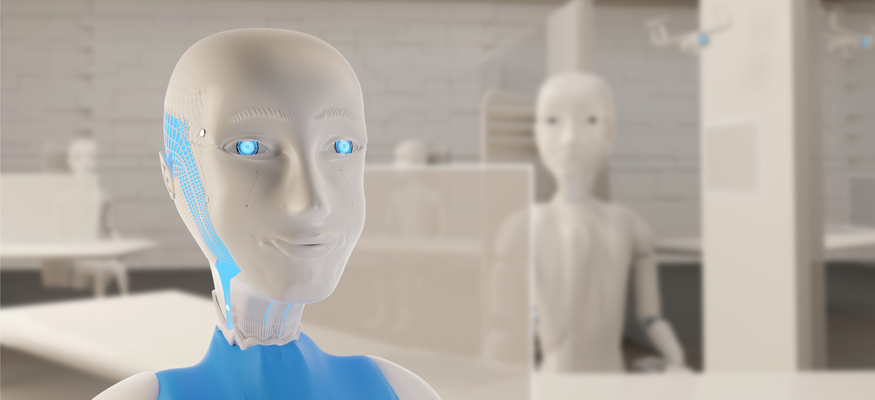
Humanoid robots are having a moment.
You can see it in investor decks, polished demo videos, and now very visibly on the floors of CES, the annual Consumer Electronics Show. But social services is not a factory, and it is not a controlled lab.
For nonprofit executives and technology leaders, the real question is not “Can a humanoid robot walk?” It is this:
Can a humanoid robot reliably assist a human being who is stressed, sick, traumatized, cognitively impaired, or unhoused, without increasing risk, cost, or harm?
This article looks at what is real, what is hype, and what a realistic adoption timeline looks like for humanoid robots in social services, including in-home care, outreach to unhoused individuals, and field support for social workers.
We begin with a brief history of robotics, examine what changed in the last three years as modern AI collided with physical machines, and close with what CES 2026 signals for nonprofit IT leaders and public-sector technology teams planning the next decade.
Why humanoid robots are being considered for social services
Across social service agencies, the pressures are familiar.
Demand for services continues to rise while staffing remains constrained. The work is physically and emotionally demanding. Environments are unpredictable, from private homes and shelters to sidewalks and vehicles. Trust, consent, and dignity are central to the mission.
Humanoid robots are being explored because, in theory, they can do something task-specific robots cannot. They can operate in spaces built for humans and use the same tools humans use.
In practice, that theoretical advantage comes with significant technical and ethical complexity. The distinction between what is technically possible and what is operationally safe and appropriate matters, especially in environments where failures can directly affect vulnerable people.
A short history of robotics, and why it matters here
Robotics did not begin with humanoids. It began with repeatability.
The first widely successful robots were industrial machines performing one task in a controlled environment. The first Unimate robot was installed at a General Motors plant in 1961 to handle dangerous, repetitive work.
The lesson still holds. Robots succeed when environments are predictable.
In parallel, researchers explored robots that could reason about the world. A landmark project was Shakey, developed at SRI between 1966 and 1972, often described as the first mobile robot able to perceive and reason about its surroundings.
From the beginning, the same tension appeared. Recognizing the world is one problem. Acting safely and reliably in it is another.
Humanoid robotics has surged repeatedly when funding, compute, or sensors improved, then stalled on the same barriers:
- Balance and dexterity
- Power consumption
- Cost
- Safety certification
- Reliability at scale
The DARPA Robotics Challenge in 2015 made this visible, with remarkable demonstrations in staged tasks and fragility in messy conditions.
For social services, this history matters. These environments are messy by default.
What changed in the last three years: from robot brains to embodied AI
From 2023 to early 2026, the robotics field shifted from better hardware to embodied AI, systems that link perception, language, and physical action.
Four changes are particularly relevant for nonprofit technology strategy.
First, better interfaces through vision-language models. Modern models allow robots to receive instructions in natural language. Instead of programming step by step, staff can describe goals such as bringing a walker or checking whether a stove is on. This matters in social services because workflows change constantly and frontline staff cannot program machines.
Second, learning from data rather than rules. Teams are moving away from brittle rule-based automation toward training from teleoperation, simulation, and real-world experience logs. This does not guarantee success, but it is a fundamentally different approach from hard-coded behavior.
Third, a shift from demos to deployment language. Companies now talk about training time, error rates, recovery from failure, and deployment timelines. Boston Dynamics’ move to an all-electric Atlas platform was framed explicitly as preparation for real-world use, not just research.
Fourth, physical AI becomes a mainstream investment theme. At CES 2026, major platform vendors signaled that robotics is now seen as a core compute market.
For nonprofit IT leaders, this matters because adoption depends on long-term vendor support, safety certification, integration with existing systems, and sustainable operating models.
What CES 2026 actually showed
CES remains where hope and hype coexist.
A consistent theme in 2026 coverage was that humanoid robots perform well in choreographed demos but still struggle with:
- Uneven surfaces
- Simple object handling
- Recovery from small errors
At the same time, the tone of the show shifted. There were fewer novelty prototypes and more production-oriented discussions. More attention was paid to where humanoids might work first, and under what constraints.
The message for nonprofit executives is not that humanoids are ready. It is that the robotics stack is maturing, but deployment will begin in controlled settings, not homes or streets.
Where humanoid robots could help in social services
The most realistic starting point is to ground this in real workflows.
In-home care assistance
Near-term assistance could include:
- Fetching and carrying light objects
- Reminders and basic check-ins
- Simple environmental checks
- Telepresence connections to clinicians or family members
High-risk tasks should be avoided early, including lifting or transferring clients, bathing and toileting, independent medication dispensing, and crisis de-escalation without trained staff.
In home care, a failure is not a software bug. It is a fall, a burn, or a crisis.
Unhoused outreach and field work
This is the hardest environment. Weather, terrain, emotion, substance use, and fragile trust all raise the risk profile.
Later-stage support roles might include carrying supplies, providing mobile charging and connectivity, and acting as a telepresence bridge to clinicians.
High-risk uses include:
- First-contact engagement
- Surveillance-adjacent functions
- Any role that displaces human relationship-building
In outreach, the job is not moving objects. It is building trust.
Shelters and transitional housing
This is the most realistic early environment.
Practical early use cases include:
- Moving supplies and laundry
- Facility rounds and hazard reporting
- Wayfinding and multilingual kiosks
- Peak-hour logistics support
These are the kinds of controlled workflows where industrial robotics succeeded first.
The real shift: from scripted machines to adaptive assistants
Traditional robotics relied on rules. If X happens, do Y.
Modern embodied AI aims for something different. Given what you see and what you were asked, choose the next safe action.
For social services, this enables faster re-tasking, more natural interaction, and better accessibility support. It also introduces a risk: over-trust.
Friendly interfaces can cause clients and staff to assume competence that does not exist. In social services, the design goal is not impressiveness. It is harm reduction.
Ethics, safety, and privacy are non-negotiable
For nonprofit leaders and public agencies, these are governance issues, not technical footnotes.
Key concerns include:
- Consent and dignity. Clients must be able to opt out without losing services.
- Surveillance risk. Robots with cameras and microphones will be perceived as monitoring, regardless of intent.
- Data security and retention. Sensor platforms introduce vendor risk, breach risk, subpoena risk, and complex retention obligations.
- Bias and unequal service quality. Systems may work better for some populations than others.
- Reliability standards. “Usually works” is unacceptable when failure means injury or neglect.
These are precisely the areas where nonprofit IT leaders must play a central governance role.
A realistic timeline for adoption
Based on current deployment patterns and CES 2026 signals, a grounded timeline looks like this.
2026 to 2027 Deployments appear first in controlled facilities, focused on logistics and kiosk-like functions with heavy supervision.
2027 to 2029 Limited pilots appear in care facilities and managed housing, focused on non-physical tasks with explicit opt-in and tight safety constraints.
2029 to 2032 Expansion occurs only if reliability improves and public trust is maintained.
Industrial leaders already speak in two-year factory deployment terms. Social services will lag that timeline for ethical and environmental reasons.
What nonprofits and IT leaders can do now
You do not need to buy a humanoid robot to prepare.
The most useful step is to map workflows where technology supports staff rather than replaces relationship-driven work. Logistics, transport, setup, and repetitive tasks are the right starting point.
Many organizations will see more immediate value from non-humanoid physical AI such as:
- Smart carts and mobile robots
- Cleaning and facility robots
- Telepresence systems
- Information kiosks
Procurement standards should reflect social services reality. Offline modes, local processing, clear retention policies, audit logs, role-based access, safety certification, and strong vendor support agreements all matter.
Governance should be designed before deployment, with input from program, clinical, legal, IT, frontline staff, and client advocates. Training and change management should be planned early. The robot is not the hard part. Workflow integration is.
What this means for nonprofit technology leaders
CES 2026 made one thing clear. Humanoid robots are no longer fringe. Physical AI is now a mainstream investment theme.
CES 2026 also reinforced a second truth. We are not at robot helpers in every home.
For social services, the likely path is:
- Facility logistics first
- Tightly scoped care pilots second
- Much later, if ever, broad in-home and outreach deployment
Throughout this evolution, humans remain accountable.
A robot can carry supplies, fetch objects, translate, and reduce repetitive strain. It cannot replace trust, judgment, empathy, or responsibility.
Final Takeaway
Humanoid robots are not a near-term solution to social services capacity challenges. They are a long-term governance challenge.
The central question for nonprofit leaders is not when to adopt robots, but how to build the decision frameworks, risk controls, and organizational discipline needed to evaluate any high-impact technology responsibly.
The organizations that succeed will not be the earliest adopters. They will be the ones that make fewer, better decisions over a longer period of time.
Ready for Guidance on Emerging Technology Strategy?
If you’re exploring broader technology strategy topics such as AI adoption and governance in your organization, “Your Nonprofit Doesn’t Need a Crystal Ball. Just a Clear and Practical AI Strategy” is a helpful companion read.
If your organization is beginning to explore AI, automation, or future assistive technologies and wants to do so thoughtfully, Varsity Technologies works with mission-driven organizations to design practical, future-ready IT strategies.
If you are evaluating how emerging technologies fit into your organization’s roadmap, you can contact us to continue the conversation.