
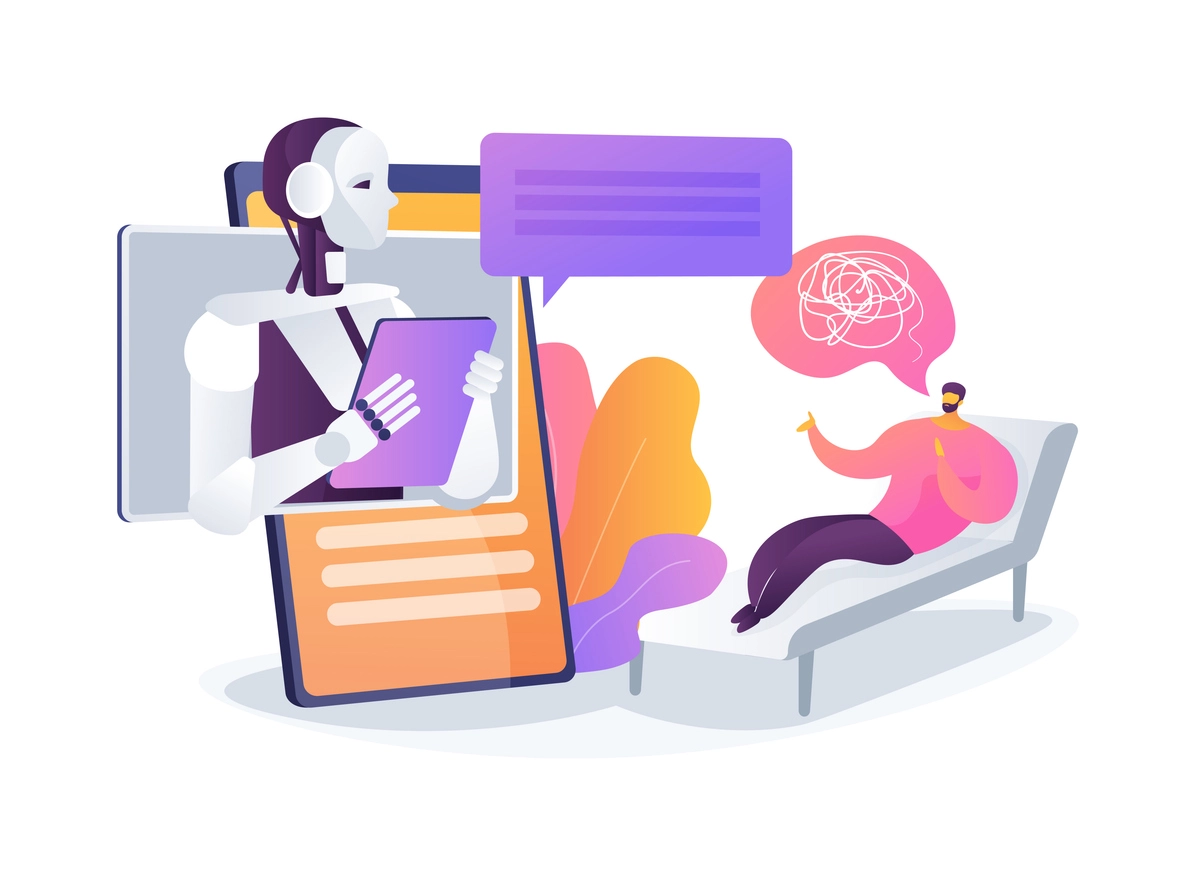
An honest look at a growing phenomenon, what it reveals about workplace wellbeing, and what the research actually shows.
It does not fit neatly into any existing category. It is not therapy. It is not a crisis line. It is not a conversation with a friend. And yet millions of people around the world are opening an AI chat window when they are struggling, anxious, lonely, or overwhelmed, and many of them report that it helps.
Understanding why this is happening, and what outcomes it is actually producing, requires setting aside both the reflexive alarm and the uncritical enthusiasm that tend to dominate this conversation. The reality is more layered than either response allows for.
How Many People Are Turning to AI for Mental Health Support
The numbers are significant and growing. A nationally representative survey conducted in the United States found that more than one in three adults now turn to AI chatbots for mental health support, with fear of judgment ranking as the single most common reason, cited by 35% of respondents, above cost (32%) and long waiting times (22.5%). A separate Brown University study published in late 2025 surveyed over 1,000 adolescents and young adults between the ages of 12 and 21, and found that 13.1% had used AI tools for mental health advice. Among those aged 18 to 21, the figure rose to one in five. Of those users, 65% engaged at least monthly, and 92.7% reported finding the advice helpful.
These figures capture a behavioral shift that has happened quickly and largely outside the formal healthcare system. Most of the AI tools involved were not designed for mental health support. They were general-purpose conversational systems that people began using for this purpose on their own, because the need was there and the access was not.
Why People Turn to AI for Emotional and Mental Health Support
The reasons are not difficult to understand once the context is clear.
The mental health care system in the United States is operating under serious structural strain. As of late 2025, 40% of the U.S. population lives in a designated mental health professional shortage area, where only 27% of need is being met. Appointment wait times range from three weeks to six months depending on location and specialty. Fifty-one percent of U.S. counties have no practicing psychiatrist at all. And for the 61.5 million adults living with a mental health condition in 2024, nearly half did not receive any treatment. Cost, provider shortages, and insurance barriers are the top reasons people give for going without.
But access is only part of the answer. The survey data cited above found that fear of judgment ranked above both cost and availability as a reason for avoiding professional care. This finding is consistent with decades of research on mental health stigma: many people do not seek help not because help is unavailable but because they do not feel emotionally safe opening up to another person. An AI system, by contrast, does not react. It does not remember the conversation the next time you meet at a family dinner. It is available at any hour, at no cost, with no waiting list and no social risk.
The workplace is where much of this pressure lands. According to Gallup research, 76% of employees experience burnout at least sometimes, a figure that has risen significantly since the pandemic. The most recent Gallup State of the Global Workplace report, published in April 2026, found that global employee engagement fell to 21% in 2024, with 44% of workers reporting daily stress. A 2026 State of Mental Health Report based on responses from over 2,000 U.S. adults found that 43% of workers have avoided telling their manager about a mental health challenge, most commonly out of fear that disclosure would have professional consequences. For these employees, AI offers something the workplace has not: a place to process stress, anxiety, and difficult experiences without social or professional risk. A Spring Health analysis published in 2026 found that 48.7% of U.S. adults had used AI tools for psychological support in the past year, with a significant share doing so specifically in work-related contexts.
A 2024 study published in a peer-reviewed journal examined 270 adults across 29 countries who regularly used ChatGPT for emotional support. Participants described using it for a wide range of purposes: working through anxiety, seeking guidance on relationships, processing difficult experiences, and in some cases, pursuing what they described as low-barrier therapeutic conversations. Researchers also noted that some users explicitly framed the interaction as a form of mindful journaling, a way of articulating and examining their own thoughts without the expectation that the tool would function as a therapist.
Availability, anonymity, and the absence of social judgment are the three factors that appear most consistently in the research as drivers of this behavior. They are not frivolous reasons. They are a direct reflection of what the existing system, including many workplace cultures, fails to provide.
What the Research Shows About AI Chatbots and Mental Health Outcomes
The evidence on outcomes is genuinely mixed, which is precisely what an honest analysis requires acknowledging.
On the positive side, a 2025 systematic review and meta-analysis covering 31 randomized controlled trials and nearly 30,000 participants found that AI chatbots showed meaningful effectiveness in reducing symptoms of depression, anxiety, and stress among adolescents and young adults. Short-term improvements in mood and reductions in loneliness have been documented in multiple studies. For users who feel that professional care is out of reach, something that reliably reduces distress in the short term is not a trivial outcome.
There are also specific populations for whom the benefits appear particularly relevant. The Brown University study identified higher usage rates among young adults with existing mental health conditions, who may face the steepest access barriers. Clinicians surveyed in a 2025 study published in Frontiers in Digital Health noted that AI tools can support engagement, provide multilingual access, and help users carry out between-session exercises that would otherwise go unsupported. A systematic review published in the British Medical Bulletin in early 2026, specifically focused on AI-based interventions in workplace mental health, found promising early evidence for their role in settings where traditional support is difficult to access or scale. These are real contributions in a system that is chronically under-resourced.
The risks are equally real and equally documented. The same clinician survey raised consistent concerns about AI’s inability to detect the subtle signals of escalating distress that are only visible in a face-to-face or voice conversation: physical presentation, tone, pauses, eye contact. These are not minor details in a mental health context. They are often the most important information available to a trained clinician.
There are also documented cases in which AI interactions during mental health crises contributed to tragic outcomes. In April 2025, the parents of a 16-year-old who died by suicide testified before the U.S. Senate about conversations in which a general-purpose AI chatbot had discouraged the young person from seeking help. Similar cases involving other platforms have resulted in legal action. The American Psychological Association has formally warned the Federal Trade Commission that chatbots presenting themselves as therapeutic tools can mislead vulnerable users in ways that carry serious risk.
A further concern identified in the research is the potential for emotional dependence. Because AI systems are designed to be responsive and consistent, some users develop patterns of reliance that may reduce rather than support their engagement with human relationships and professional care. This is not a universal outcome, but it is a documented one, and it is more likely to emerge in users who are most isolated to begin with.
Positive Psychology, the PERMA Model, and Workplace Wellbeing
To understand what people are actually reaching for when they turn to AI for emotional support, it helps to have a clear framework for what psychological wellbeing consists of. Positive psychology offers one of the most widely used.
Positive psychology is a branch of psychology founded by Dr. Martin Seligman at the University of Pennsylvania. Where traditional psychology focused primarily on diagnosing and treating mental illness, positive psychology concerns itself with what allows people and organizations to flourish. It asks not only what is wrong, but what conditions enable people to do their best work, sustain meaningful relationships, and experience a genuine sense of purpose. In a workplace context, that distinction matters considerably.
In his 2011 book Flourish, Seligman introduced the PERMA framework, which identifies five building blocks of wellbeing. Positive Emotion refers to the experience of positive feelings in daily life, including joy, gratitude, and calm. Engagement describes the state of being absorbed and invested in one’s work. Relationships captures the quality of social connection and support available to a person. Meaning refers to a sense of purpose, the feeling that one’s work and life are connected to something larger than oneself. Accomplishment describes the experience of progress and achievement. Together these five elements, PERMA, provide a practical map of what people need to be well at work, not merely to function, but to thrive.
When any of these elements is persistently absent or under strain, people look for ways to compensate. An employee who feels disengaged, isolated, or without a clear sense of purpose at work is not simply underperforming. Research in work psychology consistently shows that PERMA deficits correlate with higher rates of burnout, absenteeism, and turnover. They also correlate, as this article has documented, with higher rates of turning to external sources of support, including AI, to meet needs that are not being met through the normal channels of work and professional relationships.
Seen through this lens, the AI mental health phenomenon in the workplace is not simply a technology story. It is a signal about which elements of wellbeing are going unmet, and for how many people. For organizations genuinely committed to staff wellbeing, that signal is worth taking seriously.
What Responsible Use of AI for Mental Health Support Looks Like
None of this points toward a single conclusion. It points toward a more careful set of distinctions.
AI tools are being used for mental health support in a wide range of ways, and those ways carry very different levels of risk. Using a conversational AI to articulate anxious thoughts, organize feelings before a difficult conversation, or find language for an experience that has been hard to name is a different category of use from relying on it as a substitute for professional care during an acute mental health crisis. The former is low-risk and, for many people, genuinely useful. The latter is where the documented harms cluster.
For individuals, the most useful framing may be the one that asks not whether AI is appropriate for mental health support in general, but whether the specific use at hand is serving as a bridge toward other forms of care and connection, or as a replacement for them. When it is a bridge, it can be a valuable one. When it becomes a replacement, the risks increase substantially.
For organizational leaders and managers, the PERMA framework offers a useful starting point for a different kind of conversation. If staff are turning to AI for emotional support in significant numbers, the question worth asking is not only how to manage that behavior, but what it indicates about the state of engagement, relationships, meaning, and psychological safety in the organization. Addressing those conditions directly is the work of workplace wellness, and it is work that no AI tool can substitute for. What AI can do, responsibly used, is reduce the friction between a person in distress and the moment they decide to seek proper support.
For any organization where staff are deeply committed but chronically stretched, this is not an abstract concern. The people most likely to silently manage stress through whatever channel is available are often the same people the organization most depends on.
If you want to know more about what responsible AI use looks like, contact us.